
Your natural beauty begins with a confident smile.
Seeing Beyond the Surface
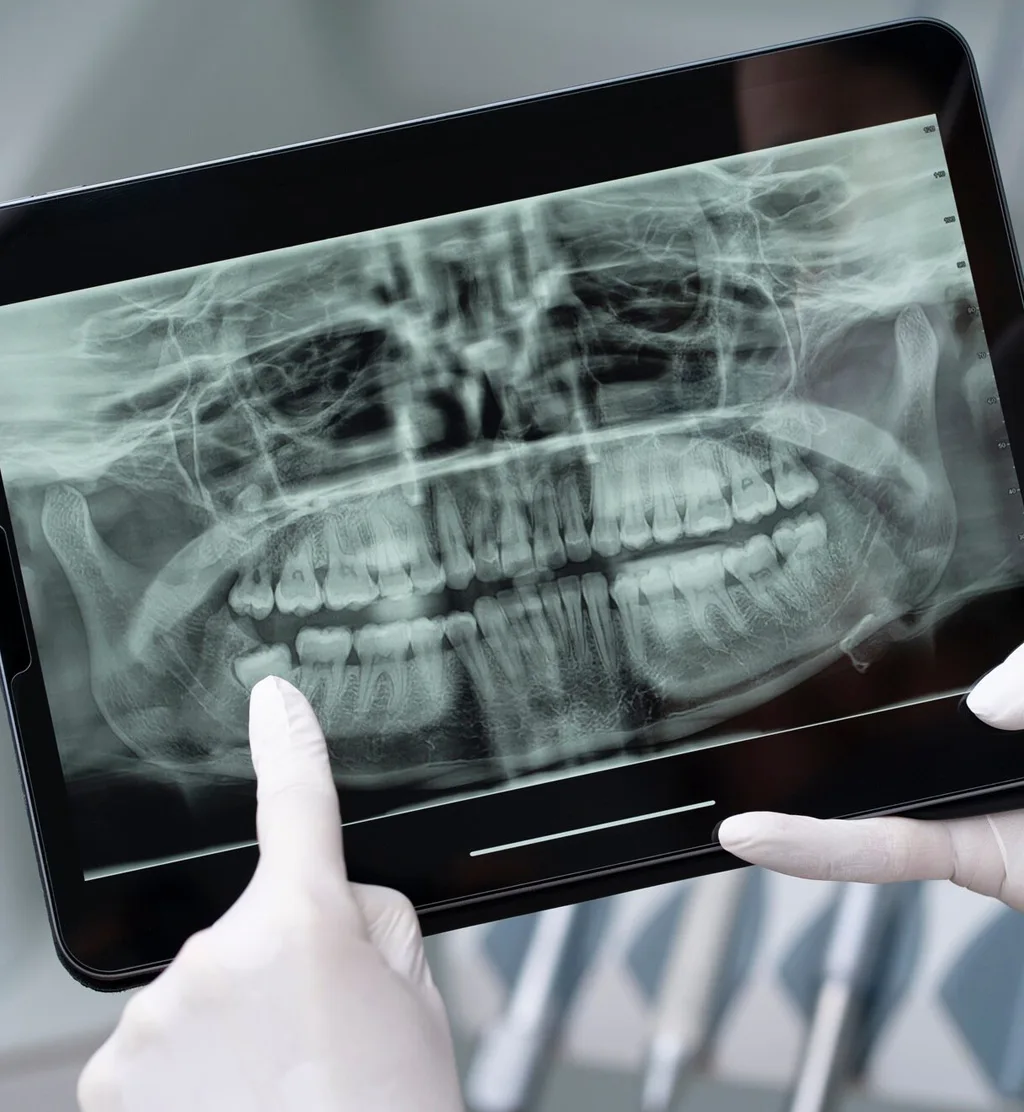
Many dental issues, such as bone loss, cysts, or decay between teeth, hide below the surface where the naked eye cannot see. To provide accurate care, we utilize advanced digital X-ray technology. Unlike traditional film, digital sensors are comfortable in the mouth and emit up to 90% less radiation, making them safe for everyone, including children.
The images appear instantly on our chairside monitors, allowing us to co-diagnose with you. We zoom in and show you exactly what is happening inside your tooth or bone structure. This transparency ensures you fully understand your diagnosis and feel confident in the treatment plan. It is precise, fast, and an essential part of modern, safe dentistry.
Which Dental X-Ray Do You Need?
Different views answer different questions, so your dentist chooses the image that fits the problem rather than taking a standard set every time.
- Bitewing: Shows the crowns of the upper and lower back teeth together. It is the main view for spotting decay between teeth and checking the bone level along the gums.
- Periapical: Shows one or two whole teeth from the biting edge to the root tip. It is used for toothache, suspected abscesses, root canal treatment and cracked teeth.
- Panoramic (OPG): A single wide image of both jaws, the wisdom teeth and the jaw joints, useful for orthodontic assessment, wisdom tooth planning and checking developing teeth in children.
- Cone-beam CT (CBCT): A 3D scan reserved for cases such as complex implant or root canal planning. Because it gives a higher dose than ordinary dental X-rays, guidance says it should be used only when simpler images cannot answer the question.
At Mankhool Dental Clinic, intraoral X-rays are taken with a digital RVG sensor. If your treatment needs a CBCT scan, your dentist will explain why and where it can be taken.
When a Dental X-Ray Is and Is Not Needed
A dental X-ray is useful when the answer lies below the surface: pain with no visible cause, a tooth that reacts to biting, swelling near a root, gum bleeding that might mean bone loss, or planning before a filling, crown, extraction, implant or braces. New patients often need baseline images, or can ask a previous dentist to send recent ones so they are not repeated.
X-rays are not taken by routine at every visit. The American Dental Association advises that images should be prescribed only when they will give diagnostic information the examination cannot. If you are, or may be, pregnant, tell the dentist; non-urgent images are often postponed, while images needed to manage pain or infection can still be taken after discussing the benefit with you.
How a Digital X-Ray Is Taken
- The dentist explains which view is needed and why.
- A small digital sensor in a holder is placed in your mouth, or, for a panoramic image, you stand or sit still while the machine moves around your head.
- The exposure takes a fraction of a second; you only need to keep still.
- The image appears on screen within seconds, and the dentist can enlarge it and adjust contrast to examine fine detail.
- The findings are explained to you and the image is stored in your record for comparison at future visits.
No anaesthetic is involved. If the sensor triggers a gag reflex, say so; a smaller sensor or a different angle can help.
Radiation, Accuracy and Honest Limits
Dental X-rays use very low doses, and dentists follow the ALARA principle: keep the dose as low as reasonably achievable by taking only necessary images, positioning carefully and reusing recent images when possible. Current ADA guidance no longer considers lead aprons or thyroid collars necessary for dental imaging, because they can block the beam and force retakes, although some clinics still use them under local rules.
An X-ray is one part of a diagnosis, not the whole of it. Very early decay, hairline cracks and some soft-tissue conditions may not show clearly, so findings are always read together with the clinical examination and your symptoms. How often you need new images depends on your age, decay and gum disease risk, and any symptoms, so the interval and the number of views (which affect the cost of a visit) vary from person to person.
Who Provides This Treatment
Diagnostic imaging for general dental care is arranged and interpreted by Dr. Christopher Cura Vicencio, a General Dentist at Mankhool Dental Clinic since 2011 and a graduate of the University of the East College of Dentistry. He uses the clinic’s digital X-rays to explain findings on screen and, where an image shows a problem needing specialist care, works with the clinic’s specialist endodontist, orthodontist and periodontist.
Why Choose Mankhool Dental Clinic ?
Minimal Radiation
Our digital sensors emit up to 90% less radiation than traditional film X-rays.Instant Images
Results appear on screen immediately, shortening your appointment time.Transparent Diagnosis
We review the images with you on a large monitor so you understand the "why" behind the treatment.Comfortable Sensors
We use modern sensors designed to fit comfortably in your mouth.Enhanced Detail
Digital zooming allows us to spot tiny fractures or hidden decay early.Eco-Friendly
No harsh chemicals are used to develop the images, making it better for the environment.Other Treatments We Offer
Oral Examinations & Screenings
Tooth Extractions
Difficult Tooth Removal
Tooth Colour Fillings
Crowns & Bridges
Dentures
Fluoride & Sealants
Mouthguards & Nightguards
Bonding
Teeth Cleaning
Zoom Whitening
The check-up was quick and thorough. The dentist explained everything clearly, and I left feeling confident about my oral health.
Great clinic for routine care - clean, friendly, and efficient. My teeth feel better after every visit.


Frequently Asked Questions
Are dental X-rays safe?
Why do you need X-rays?
Can I refuse X-rays?
How often are they needed?
Are they safe for pregnant women?
Do you use 3D imaging?
Why choose us as your dental services provider?
Our office is equipped with the latest equipment and technology to bring a high level of excellence to the care we provide. You’ll feel right at home thanks to our friendly team and service-minded approach.
Dr. Christopher Cura
At Mankhool Dental Clinic, we blend advanced expertise with genuine care to transform your dental visits into empowering experiences. Choose us for smiles that last.
Ready to Book Your Appointment?
Contact us today to schedule your visit and take the first step toward a healthier smile.
